
How to Calculate Life Path Number
Your Life Path Number is the most important number in numerology. To calculate your life path number, use your complete birth date and reduce the month, day, and year with one consistent method. This guide shows the manual steps, but you can also use the free life path number calculator to check the result instantly.
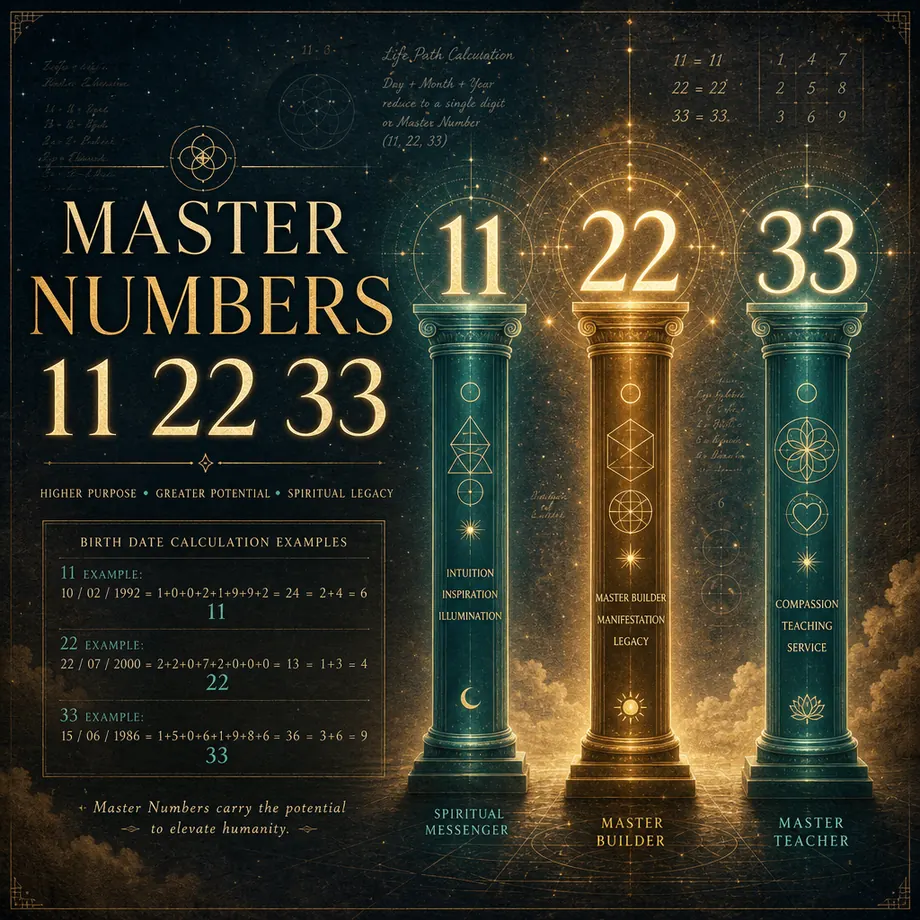
How to Calculate Life Path Number: The Method
- Step 1: Reduce your birth month to a single digit (e.g., December = 12 → 1+2 = 3).
- Step 2: Reduce your birth day to a single digit (e.g., 25 → 2+5 = 7).
- Step 3: Reduce your birth year by adding all digits (e.g., 1990 → 1+9+9+0 = 19 → 1+9 = 10 → 1+0 = 1).
- Step 4: Add the three reduced numbers together and reduce to a single digit.
- Master Numbers: If you get 11, 22, or 33 at the final step, don't reduce further—these are special Master Numbers with amplified energy.
For searchers asking how to calculate life path from a birth date, the key rule is consistency: reduce the month, day, and year separately first, then add those three values. This keeps the calculation readable and makes master number checks easier to verify.
Skip the math and get your result instantly with the free calculator:
Calculate My Life Path NumberUnder the method used on this site, keep 11 or 22 when the final total lands on that number. A master subtotal in the month, day, or year does not automatically make the final life path a master number.
Most disagreements come from the treatment of intermediate master numbers. One method adds every digit in the full date at once. Another reduces the month, day, and year separately before adding them. A third method preserves 11 or 22 in a subtotal, then checks the final total again. These approaches usually produce the same single digit, but rare dates can expose a different master-number layer.
When comparing a result, ask three questions: Did the calculator use the complete birth date? Did it show the month, day, and year steps? Did it say whether 11, 22, or 33 is preserved? A transparent explanation is more useful than a bare number. If two tools disagree, write down both methods, choose one convention, and use it consistently when reading the life path numbers chart or the master numbers guide.
Use the date recorded on your birth certificate and keep the order clear. In the examples above, “September 4, 1998” means month 9, day 4, and year 1998. Do not substitute your current age, birth time, name number, or a zodiac date. If you were born close to midnight, use the civil date recorded for the place and time of birth unless your numerology system explicitly instructs otherwise.
Leap day birthdays are handled as February 29 in the birth date calculation. A leading zero in a month or day does not change its digit sum: 07 is still 7, and 04 is still 4. The year should be written with all four digits, including a zero when present. These small details prevent accidental month-day swaps and make your manual result easier to reproduce.
For an ordinary result, you can use a quick digit-sum check after writing out the full date. Add every digit once, then keep adding the digits of the total until one digit remains. For July 16, 1992, the full sum is 7+1+6+1+9+9+2 = 35, and 3+5 = 8. This confirms the final single digit shown in the longer month-day-year calculation.
Use the shortcut as a check, not as a replacement for the visible method. A quick digital-root calculation can hide whether an intermediate total was 11 or 22. If a master number matters to your reading, keep the month, day, year, and final total on separate lines, then compare the result with the master numbers guide.
Ready to discover your Life Path Number?
Use our free calculator to find your number instantly—no math required.