
Personal Year vs Life Path Number
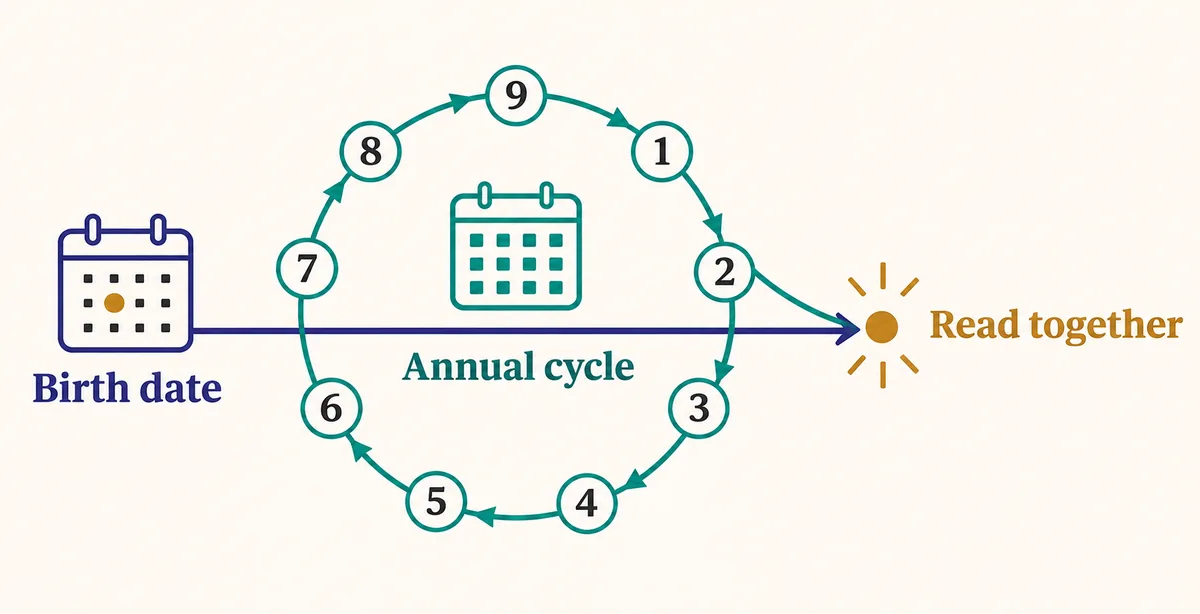
Short answer: a Life Path Number is the long-term pattern calculated from your complete birth date, while a Personal Year Number is the theme of a particular year calculated from your birth month, birth day, and target year. In a personal year vs life path number reading, the first number supplies context and the second supplies timing. They are not competing scores, and one does not replace the other.
This article is an interpretation guide, not another calculator. Use the Personal Year Calculator to get the annual result, then use the Life Path Number Calculator for the fixed birth-date number. Keeping the two jobs separate makes the comparison easier to audit.

Personal Year vs Life Path Number: The Difference at a Glance
Both numbers use your birth information, which is why they are often confused. Their time scale and question are different. The table below gives you a quick boundary before you read the longer examples.
| Comparison | Life Path Number | Personal Year Number |
|---|---|---|
| Input | Complete date of birth | Birth month + birth day + target year |
| Time scale | Long-term and stable | One calendar year under the chosen convention |
| Main question | What recurring themes shape my direction? | What theme is emphasized in this year? |
| Typical use | Identity, lessons, strengths, and broad compatibility | Planning, reflection, priorities, and a current chapter |
| Can it change? | Not when the birth date is fixed | Yes, it advances through a nine-year cycle |
Treat those descriptions as the vocabulary of a symbolic system. They are prompts for reflection, not measurements of character or guarantees about an outcome.
What a Life Path Number Measures
A Life Path Number uses the full date on a birth record. The site’s standard method reduces the month, day, and year, adds those values, and then reduces the final total while preserving a supported master number when the rule calls for it. Because the input date does not change, the resulting number is usually treated as a stable reference point.
In practical language, a Life Path reading asks about patterns that may return across different stages of life: how someone approaches responsibility, independence, learning, communication, or service. It does not describe every event or every trait. A person can recognize a theme without acting it out in the same way in every situation.
Browse the Life Path Numbers guide for fixed-number meanings or the Life Path Number meaning page for a deeper result reading; this article adds the time-based comparison.
What a Personal Year Number Measures
A Personal Year Number is a moving lens. It combines your birth month and day with the digits of a target year, then reduces the total according to one stated method. The result is commonly read as a theme for a calendar year: a year 1 may invite beginnings, a year 4 may reward structure, and a year 9 may emphasize completion and release.
The annual number does not erase your Life Path. It is closer to a season placed on top of a longer route. A Life Path 4, for example, can still value systems during a Personal Year 5, but the year may ask that person to experiment or adapt instead of repeating a familiar routine. The contrast is the useful part of the reading.
Our Personal Year Calculator uses the calendar-year convention and shows the math. If you use a birthday tradition, record that convention beside the result.
How to Calculate Both Numbers Side by Side
Use one method from start to finish and keep the labels attached to every subtotal. Here is a transparent example using July 16, 1992 and the target year 2026.
- Calculate the Life Path. July is 7. The day 16 becomes 1 + 6 = 7. The year 1992 becomes 1 + 9 + 9 + 2 = 21, then 2 + 1 = 3. Add 7 + 7 + 3 = 17, then 1 + 7 = 8.
- Calculate the Personal Year. Keep the same birth month 7 and reduced day 7. The target year 2026 becomes 2 + 0 + 2 + 6 = 10, then 1 + 0 = 1. Add 7 + 7 + 1 = 15, then 1 + 5 = 6.
- Label the result. The reading is Life Path 8 with Personal Year 6 for 2026. The 8 is the long-term context; the 6 is the current annual emphasis.
| Reading | Math | Result |
|---|---|---|
| Life Path | 7 + (1 + 6) + (1 + 9 + 9 + 2 → 3) = 17 → 1 + 7 | 8, long-term context |
| Personal Year 2026 | 7 + (1 + 6) + (2 + 0 + 2 + 6 → 1) = 15 → 1 + 5 | 6, annual emphasis |
| Personal Year 2027 | 7 + (1 + 6) + (2 + 0 + 2 + 7 → 2) = 16 → 1 + 6 | 7, next annual emphasis |
See the step-by-step calculation guide for manual Life Path math. For a new year, change only the Personal Year target year.
How to Combine Personal Year and Life Path Number
A useful combined reading follows a simple order: context first, timing second, action third. This prevents the annual number from being treated as a permanent identity label and prevents the fixed number from swallowing the question about the current year.
1. Name the long-term pattern
Write one grounded phrase for your Life Path, such as structure, expression, investigation, or service. Keep it descriptive rather than absolute.
2. Add the annual lens
Read the Personal Year as the part of the nine-year cycle that is most visible now. Ask what it supports, asks you to practice, or asks you to finish.
3. Look for fit or friction
A matching theme may feel focused. A different theme may suggest a useful stretch. Neither combination is automatically good or bad.
4. Choose a real-world question
Turn the symbols into a small prompt: What needs a system? What needs honest expression? What can be completed? Use evidence from your life to answer it.
Worked Examples: Matching, Supporting, and Tense Combinations
The following examples show how to use the comparison without claiming that a number forces an event. The combinations are reading prompts, not predictions.
| Combination | Possible reading question | Grounded next step |
|---|---|---|
| Life Path 4 + Personal Year 4 | Where could a repeated structure become more reliable? | Choose one routine, budget, or skill system and define a finish line. |
| Life Path 7 + Personal Year 3 | How can private analysis become clear expression? | Share one researched idea through writing, teaching, or a focused conversation. |
| Life Path 8 + Personal Year 2 | How can achievement include patience and partnership? | Review a negotiation or team decision before pushing for speed. |
| Life Path 5 + Personal Year 4 | What kind of structure protects useful freedom? | Keep the experiment, but add a schedule, savings limit, or review point. |
If you are comparing two people, use the site’s Life Path compatibility calculator for the relationship task. A Personal Year belongs to a person and a year; it is not a permanent compatibility label.
Timing Rules, Master Numbers, and Responsible Limits
Different numerology schools use different reduction rules. Many preserve 11 and 22 when they appear at the relevant Life Path step; some also preserve 33. Personal Year readings are commonly reduced to 1–9 because they describe a repeating nine-year cycle. When a source gives another result, compare the formula and the point at which it preserves a master number before comparing the interpretation.
The calendar-year convention names one January-to-December window, while some traditions use a birthday transition. Write down the convention, target year, birth date, and sums so the reading can be reproduced.
Numerology is a symbolic belief system, not a scientific test. Do not use a Personal Year or Life Path result as a substitute for medical, legal, financial, relationship, or safety advice. The most reliable part of this exercise is the transparent calculation and the questions it helps you ask about your real priorities.
Personal Year vs Life Path Number FAQ
Is a Personal Year the same as a Life Path Number?
+
Is a Personal Year the same as a Life Path Number?
+Which is more important, Personal Year or Life Path?
+
Which is more important, Personal Year or Life Path?
+How do I calculate a Personal Year number?
+
How do I calculate a Personal Year number?
+Can my Personal Year match my Life Path?
+
Can my Personal Year match my Life Path?
+Does a Personal Year change on my birthday?
+
Does a Personal Year change on my birthday?
+Can numerology predict what will happen this year?
+
Can numerology predict what will happen this year?
+What should I do after comparing the two numbers?
+
What should I do after comparing the two numbers?
+Calculate both numbers and read them together
Start with the fixed birth-date result, then check the target year. Keeping the two inputs and methods visible makes your comparison easy to revisit.